How to do the Traslatio Route step by step ⛵
If you are walking the Spiritual Variant of the Portuguese Camino, there will come a moment when you will complete one of the most special stages of the entire Camino: the Traslatio Route.
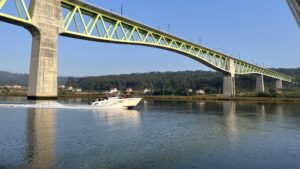
Unlike the rest of the stages, this part of the route is not done on foot, but by sailing through the Ría de Arousa and the Ulla River until reaching Pontecesures.
Many pilgrims who plan this variant often wonder:
when the Traslatio Route takes place
what happens when arriving in Vilanova de Arousa
when the boat departs
what happens after arriving in Pontecesures
In this guide we explain how to do the Traslatio Route step by step, from the moment you arrive walking in Vilanova de Arousa until you continue your Camino toward Santiago de Compostela.
When the Traslatio Route takes place during the Camino 🚶♂️
The Traslatio Route is usually done on the third day of the Spiritual Variant.
A common itinerary for this variant is:
- Day 1: Pontevedra – Armenteira
- Day 2: Armenteira – Vilanova de Arousa
- Day 3: Traslatio Route by boat
Therefore, the boat journey takes place after arriving on foot in Vilanova de Arousa.
Arriving on foot in Vilanova de Arousa
Most pilgrims arrive in Vilanova de Arousa walking from Armenteira, after completing the famous Ruta da Pedra e da Auga, one of the most beautiful trails of the Camino.
This stage usually finishes around midday or early afternoon.
- For this reason, it is common to:
- arrive walking in Vilanova
- stay overnight in the town
- rest do the Traslatio Route the following day
Vilanova de Arousa is a peaceful seaside town where many pilgrims take the opportunity to walk around the port or enjoy the local gastronomy before continuing their Camino.
Doing the Traslatio Route the following day 🚤
Departures for the Traslatio Route usually take place in the morning, which is why most pilgrims do the journey the day after arriving in Vilanova de Arousa.
Boarding takes place at the Mar de Santiago Maritime Station, located in the port of Vilanova de Arousa.
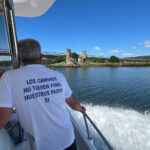
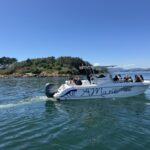
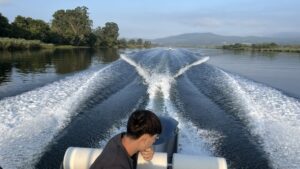
From there the maritime journey begins, sailing through the Ría de Arousa and later entering the Ulla River.
The trip lasts approximately 1 hour and 15 minutes until reaching Pontecesures.
In some cases afternoon departures are also organized, although the most common option is to take the route in the morning.
What happens during the Traslatio journey 👀
During the Traslatio Route, pilgrims sail through some of the most spectacular landscapes of the Galician coast.
During the journey you can see:
- the famous mussel rafts (bateas) 🦪
- Cortegada Island
- the stone crosses of the maritime-fluvial Way of the Cross
- the historic Torres de Catoira
In addition, during the journey we stamp the pilgrim credential, a very special memory of this stage of the Camino.
What to do after the Traslatio Route
The journey ends in Pontecesures, a town located very close to Padrón.
From there pilgrims continue walking to Padrón, which is located approximately 3 kilometers away.
Many pilgrims choose to spend the night in Padrón and the following day complete the final stage of the Camino to Santiago de Compostela.
Why the Traslatio Route is such a special stage ✨
The Traslatio Route is a unique experience within the Camino de Santiago because it combines history, nature and tradition.
It allows pilgrims to:
- follow the historic route of the transfer of the Apostle
- discover the spectacular Ría de Arousa
- experience the only maritime stage of the Camino
For this reason, for many pilgrims the Traslatio Route becomes one of the most memorable moments of the entire pilgrimage.
🚤 If you are walking the Spiritual Variant of the Portuguese Camino, doing the Traslatio Route is a unique way to complete your Camino before arriving in Santiago de Compostela.