Traslatio of the Camino de Santiago: the original sea route 🚢
The Traslatio of the Camino de Santiago is much more than a boat trip. It is the only official maritime stage of the Camino, a historic and spiritual journey that follows the legendary transfer of the body of Saint James through the Ría de Arousa and the Ulla River.
Every year, thousands of pilgrims search online for information about the Traslatio, often finding fragmented or unclear explanations. In this article, you will discover what the Traslatio is, why it is so important in the history of the Camino, and how you can experience it today in an authentic and organised way 🌊.
What is the Traslatio of the Camino de Santiago?
The Traslatio is the maritime route that forms part of the Spiritual Variant of the Portuguese Camino. According to Jacobean tradition, after the martyrdom of Saint James in Jerusalem, his disciples transported his body by sea to Galicia, sailing across the Ría de Arousa and navigating upstream along the Ulla River to Padrón.
👉 This journey is considered the true origin of the Camino de Santiago, as it represents the first journey of the Apostle towards Compostela.
Today, the Traslatio allows pilgrims to relive this ancient legend from the sea, turning it into one of the most symbolic and emotional experiences of the entire Camino.
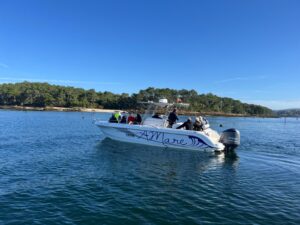
The only maritime route of the Camino de Santiago ⚓
What makes the Traslatio of the Camino de Santiago truly unique is that it is the only officially recognised stage completed by boat. During the journey, pilgrims travel through landscapes filled with history and meaning:
-
🪵 Traditional mussel rafts of the Ría de Arousa
-
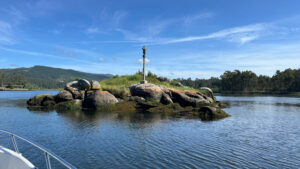
✝️ The Maritime-Fluvial Way of the Cross, marked by 17 stone crosses visible from the water
-
🏰 The historic Towers of Catoira, built to defend Galicia from Viking invasions
-
🌿 The peaceful transition from open sea to the calm waters of the Ulla River
It is a route that perfectly combines history, spirituality, nature and local maritime culture.
Where does the Traslatio route start and end?
🚩 Starting point
The Traslatio usually begins in Vilanova de Arousa, although departures are also available from other ports along the Ría de Arousa, such as:
-
Illa de Arousa
-
Vilagarcía de Arousa
-
Cambados
-
Carril
🎯 Final destination
The maritime journey ends in Pontecesures, where pilgrims continue on foot to Padrón and then towards Santiago de Compostela.
⏱️ Approximate duration:
-
1 hour 15 minutes (one way)
-
2 hours (round trip)
Who can do the Traslatio?
The Traslatio is suitable for:
-
🥾 Pilgrims walking the Spiritual Variant
-
🌍 Travellers interested in history and Jacobean heritage
-
❤️ People looking for a meaningful and different experience
-
👨👩👧👦 Families and small groups (no need to walk the entire Camino)
No previous experience or special physical condition is required.
How can you experience the Traslatio today?
Today, the best and most common way to complete the Traslatio is by boat with a specialised local operator experienced in the maritime route of the Camino de Santiago.
Departures and season
-
📆 April to October: daily guaranteed departures
-
❄️ November to March: available on request (minimum number of passengers required)
Departure times depend on the tides, which is why advance booking is highly recommended.
👉 You can find official information about the Camino at the Pilgrim’s Office
It is also recommended to check the official website of the Spiritual Variant for more information.
An authentic experience through the Ría de Arousa 🌿
Completing the Traslatio is not just about finishing a stage — it is about understanding the origins of the Camino from the sea, listening to stories told by local sailors, and observing the landscape exactly as the first pilgrims once did.
Live the Traslatio and complete your Camino in a unique way ✨
If you are planning to walk the Spiritual Variant or simply wish to discover the true origin of the Camino de Santiago, the Traslatio of the Camino de Santiago is an unforgettable experience.
🚢 Check schedules, availability and book your place to sail through the living history of the Camino.
👉 Book your Traslatio and experience the Camino from the sea