

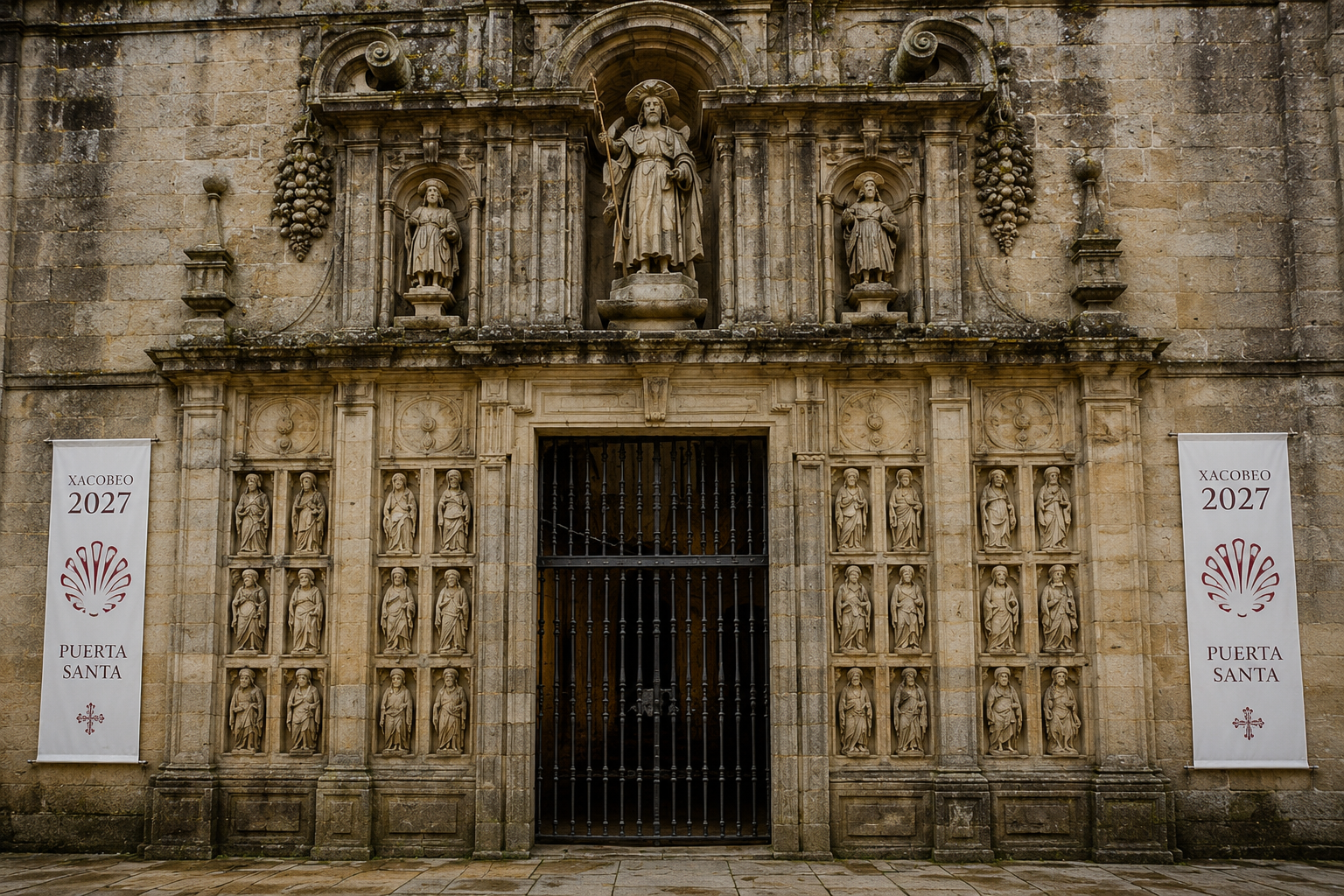
Holy Door of Santiago: Guide to Xacobeo 2027
If you are thinking about walking the Camino de Santiago, 2027 will be an especially significant year. It will be a Holy Year in Santiago, popularly known as Xacobeo, and one of its great symbols will once again take centre stage: the Holy Door of Santiago.
For many pilgrims, crossing this threshold means much more than entering the Cathedral. It is one of the most recognisable symbols of the Holy Year and can become the perfect ending to weeks of walking, encounters and experiences along the Camino.
But why does it open in 2027? Where is it located? What does it mean? And how can you prepare your Camino?
Here is what you need to know to start planning your pilgrimage for Xacobeo 2027. 🥾
Why is 2027 a Holy Year in Santiago?
A Compostelan Holy Year is celebrated whenever 25 July, the Feast of Saint James the Apostle, falls on a Sunday. This will happen again in 2027.
Holy Years have an important religious, historical and cultural dimension and attract pilgrims from around the world.
For official information about the Holy Year, visit the Santiago Cathedral website.
When will the Holy Door open for Xacobeo 2027?
The opening of the Holy Door traditionally marks the beginning of the Holy Year.
The ceremony takes place on 31 December preceding the Holy Year, meaning that the ceremony opening Xacobeo 2027 will take place on 31 December 2026.
Anyone planning to visit Santiago for the event should check official information beforehand, as access arrangements and schedules may vary.
What is the Holy Door of Santiago?
The Holy Door of Santiago, also known as the Door of Forgiveness, is located at the rear of the Cathedral and is accessed from Praza da Quintana.
During ordinary years it remains closed, opening to pilgrims during a Compostelan Holy Year.
📍 After walking tens or even hundreds of kilometres, reaching this symbolic entrance can be an emotional moment.
It is not simply a monumental doorway. For many travellers, it represents the end of a journey that combines physical effort, history, culture, spirituality and personal experiences.
Is it necessary to cross the Holy Door to obtain the indulgence?
This is one of the questions that may arise when preparing the Camino during a Holy Year.
Although crossing the Holy Door of Santiago is one of the best-known and most symbolic gestures of Xacobeo, crossing it is not in itself a mandatory requirement for obtaining the Jubilee indulgence.
If you are walking the Camino for religious reasons and want to know the exact conditions established for the 2027 Jubilee, we recommend consulting the information published by Santiago Cathedral [EXTERNAL LINK → https://catedraldesantiago.es/].
Where is the Cathedral’s Holy Door?
The Holy Door is located in Praza da Quintana, at the eastern end of Santiago de Compostela Cathedral.
Its location makes this square one of the key places in the city during the Holy Year.
If you are planning to walk the Camino in 2027, it is worth remembering that Santiago will receive special attention throughout the year. For this reason, organising aspects such as accommodation, transport and certain stages of the Camino in advance can help you enjoy a much more relaxed pilgrimage.
Preparing the Camino de Santiago for Xacobeo 2027
If you already know that 2027 will be your year to walk the Camino, there is no need to wait until the final months to start organising it.
One of your first decisions will be choosing your route. The French Way, Portuguese Way, Primitive Way and Northern Way are some of the possibilities, but there is another particularly interesting alternative for those who want to combine nature, history and Jacobean tradition: the Spiritual Variant of the Portuguese Way
This variant leaves the traditional route of the Portuguese Way in Pontevedra and takes pilgrims through places such as Poio, Combarro, Armenteira and Vilanova de Arousa.
And it is precisely in Vilanova where one of its most unique experiences begins.
From the Traslatio Route to the Holy Door
The Traslatio Route is the maritime stage of the Spiritual Variant and connects Vilanova de Arousa with Pontecesures on an approximately 1 hour and 15 minute journey through the Arousa Estuary and the Ulla River. ⛵
The journey follows the route associated with the Jacobean tradition of the transfer of the body of Saint James the Apostle to Galicia.
During the journey, you can learn about the mussel platforms and mussel farming, admire Cortegada Island, follow the stone crosses of the Maritime-Fluvial Way of the Cross, discover the Towers of Catoira and watch the landscape of the Arousa Estuary gradually change as you enter the Ulla River.

The journey ends in Pontecesures, from where pilgrims continue on foot towards Santiago de Compostela.
For this reason, walking the Spiritual Variant during Xacobeo 2027 can have a very special symbolism: sailing along the route associated with the tradition of the Apostle’s arrival in Galicia and then continuing on foot to Santiago and the Holy Door.